How much should AI cost your business?
The honest answer is that it depends less on which AI plan you buy and more on how well you understand the way your team will actually use it. Businesses that treat AI spend as a plan-tier decision tend to either overspend on licences nobody uses properly, or underspend and wonder why they aren't seeing a return. The plan matters less than the usage pattern sitting underneath it.
Most businesses compare Claude and ChatGPT the way they'd compare two phone plans, on price and headline features. But the real cost of AI in your business isn't the subscription line. It's how well the tool is matched to the work being done across your team, and whether anyone is watching what that work actually needs.
Claude or ChatGPT: what are you actually choosing between?
For most growing businesses, the decision comes down to two tools: ChatGPT and Claude. Both now offer a similar shape of plan, a mid-tier option built for individuals who need broader tool connections and stronger privacy controls, and a business or team plan built for shared workspaces, admin controls and data protections that matter once more than one person is using the tool for client or company information.
Which one you pick matters less than most people assume, unless you need a specific feature, like a particular integration, a connector to your existing systems, or a model your team is already invested in. Pricing on both changes often enough that we caution being prepared for changes in the future, but at the time of this post being published, here’s a brief summary of your plan options and the costs involved below.
For most regular users, AI costs about US$20 per month.
For heavy individual users, the cost rises to roughly US$100-$200 per month, with US$150/month a fair middle estimate.
For business users, standard AI seats generally sit around US$20-$30 per user per month, but heavier usage or enterprise requirements can push that much higher.
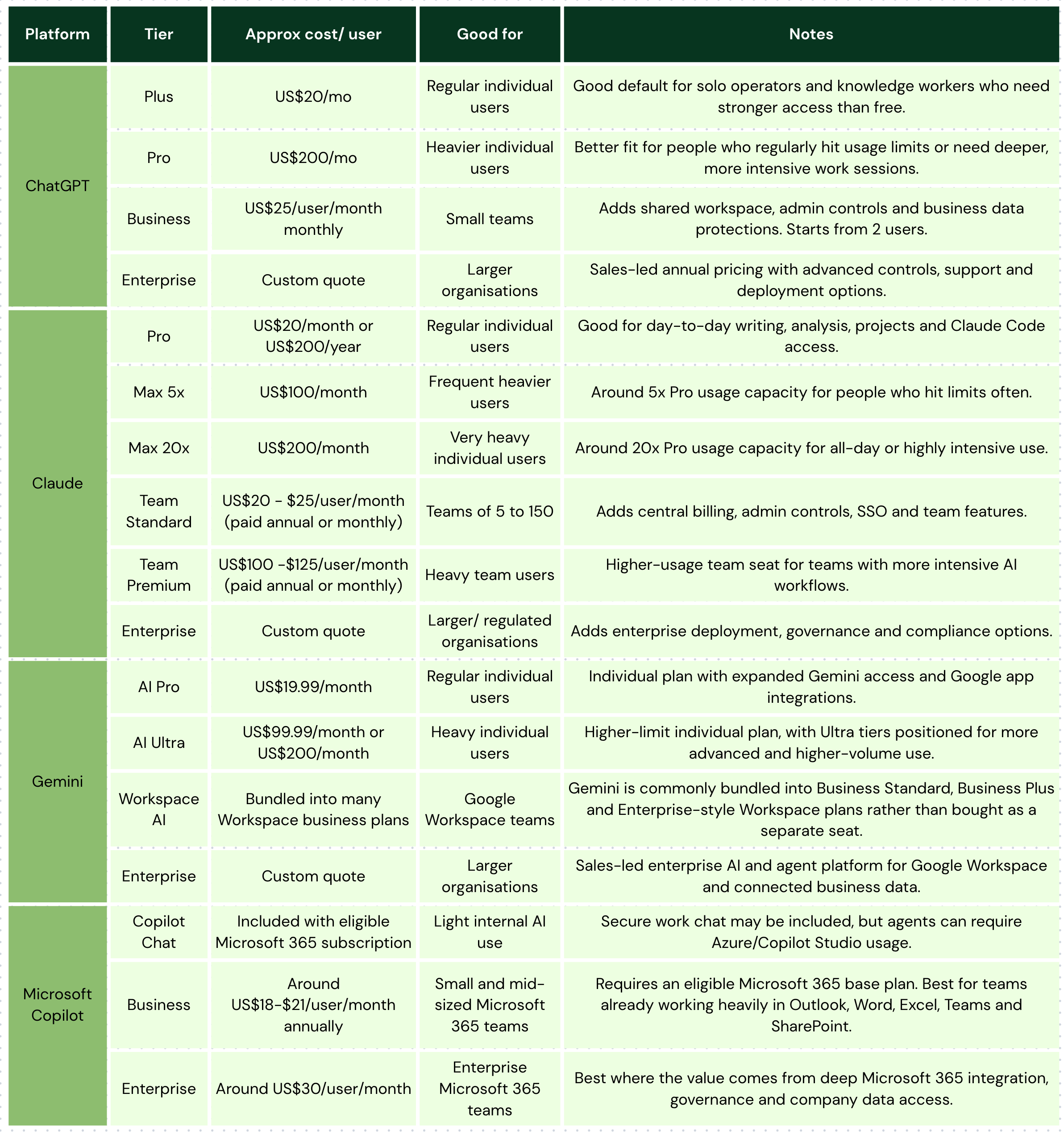
Breakdown of costs from popular AI platforms - as of 14th July 2026.
Why "how much does this cost" is the wrong first question
The bigger issue isn't the subscription fee, it's how you plan to use the tool and the associated usage limits sitting behind it.
Claude works on a rolling five hour window, so heavy use in the morning eats into what's available by early afternoon, then gradually frees up again. There are options to buy more credits to keep working, however this makes forecasting your budget and associated costs much more difficult.
ChatGPT handles it differently: instead of a hard cutoff, it starts quietly answering with a lighter model once you've used enough of your allowance, and it caps things like deep research separately again.
Planning for these limitations involves understanding what your team will be using AI for, and the volume of it.
The real driver of cost is the kind of work being done
This is where the plan-tier question stops being useful and the usage question starts. Take a tourism business as an example, and look at three different roles:
Frontline staff handling bookings, reservations and guest queries typically need basic access, often through a custom assistant that keeps responses consistent and helps draft emails quickly. Some businesses push this further, scheduling daily summary reports or using an assistant to triage incoming questions before a person steps in.
Managers in marketing and sales are usually doing higher-context work: coordinating reports, building campaign assets, running research. They need broader access, including tool connections, and will often benefit from a "digital teammate" set up to handle recurring reporting or wrap-up tasks automatically.
Super users, often department heads or operations leads, are processing large volumes of information rather than producing content. They need the most advanced access, but tend to use it in shorter, higher-value bursts, more often managing what the digital team members are doing than doing the execution themselves.
Spread those three patterns across a whole company and the licence costs stack up fast. If some of those seats aren't being used anywhere near their potential, it starts to look like wasted spend, even when the tool itself is doing exactly what it's meant to.
What this actually costs your business
The subscription is the smallest part of the equation. The real cost sits in the time people spend using the tool, how confident they are while doing it, and how well that time maps back to work that actually matters to the business. Two people on the same plan can produce wildly different value, and that gap is almost never about which model they're using.
Before deciding what to spend, it's worth categorising the work itself: what's being done, how much time it takes, and how confident your team already feels doing it with AI involved. That gives you a much clearer picture than comparing plan prices ever will.
Where to start?
Start small. Categorise the work happening across your team before you categorise your spend. Invest more heavily in the roles and use cases where the pain points are real, not where the loudest request came from. And it's worth asking a question most businesses skip: does your team see this as something that improves how satisfying their work is, not just how fast it gets done? That answer tends to point straight at where the next investment should go.
Frequently asked questions
-
Neither is a clear winner on value alone. The better question is which tool matches the way your team already works, and whether you need a specific feature like a connector, integration or privacy control that only one of them offers. Pricing shifts regularly, so check current plans before comparing on cost alone.
-
Claude works on a rolling five hour window, so usage gradually frees up rather than resetting on a fixed clock. ChatGPT tends to quietly shift to a lighter model once you've used a chunk of your allowance, and applies separate limits to features like deep research. Planning heavier, more strategic work earlier in a session helps avoid running into either.
-
Look past the subscription cost. Map out what each role is actually using the tool for, how much time it saves, and how confident people feel using it. If several licences are sitting mostly unused, that's a usage problem to solve before it's a plan problem to fix.
If you're trying to work out where your team's AI spend should actually be going, an AI Readiness assessment is a practical place to start. Get in touch to learn how this can help your business.